

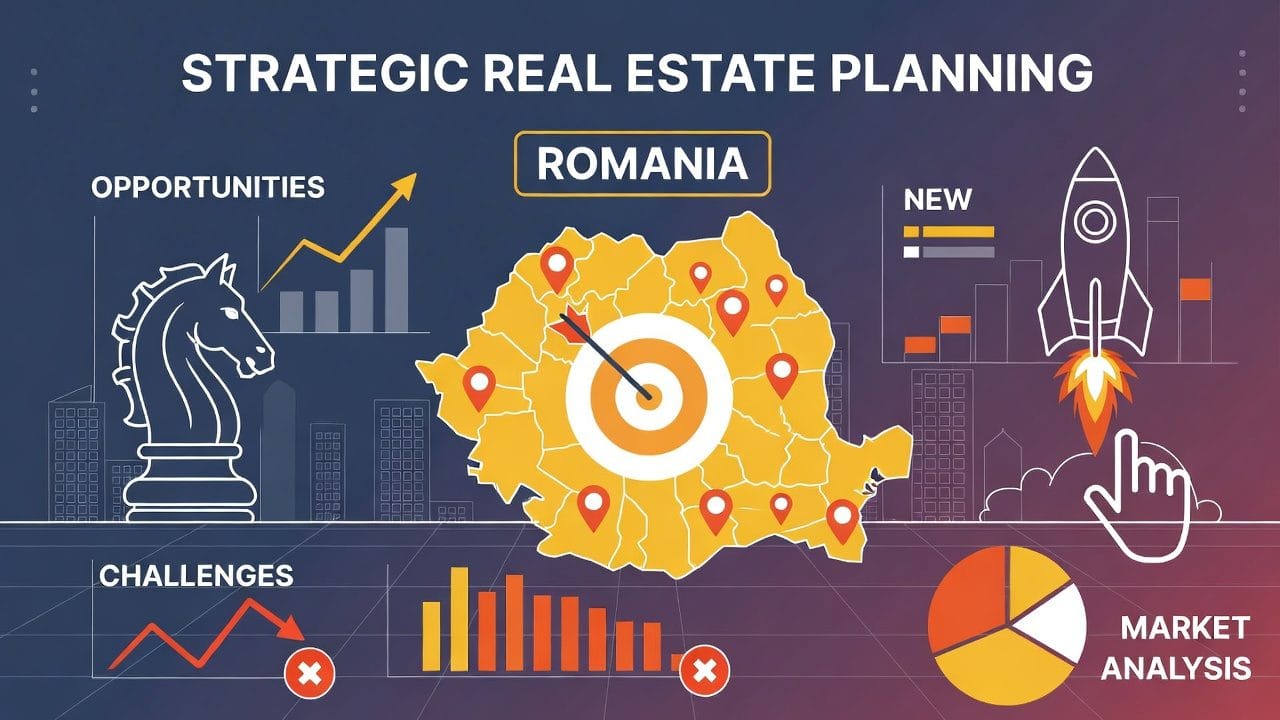
Strategy, Risks, Returns and Where Smart Capital Is Moving
Romania is entering a decisive investment window. Between accelerated infrastructure delivery, EU funding deadlines, renewable energy targets and logistics reshoring trends, land has become one of the most asymmetric asset classes in Central and Eastern Europe.
This guide explains why Romania matters in 2026, which land segments outperform, how risks actually work in practice, and how foreign investors can structure acquisitions for capital protection and scalable exits.
Why Invest in Romanian Land in 2026
Romania combines EU and NATO institutional backing with still-undervalued land pricing. While Western European markets are fully priced and yield-compressed, Romania offers higher risk-adjusted returns for investors willing to navigate zoning, permitting and infrastructure timing.
Key macro drivers shaping 2026:
GDP growth remains positive despite fiscal tightening
EU funding absorption peaks before the August 2026 NRRP deadline
Major highway corridors (A0, A7, A8) materially change land accessibility
Renewable energy expansion requires 10.9 GW of new capacity by 2030
Industrial and logistics demand continues driven by nearshoring and e-commerce
Romania is no longer a speculative frontier market, but it is still early compared to Poland or Czechia.
Land as an Asset Class in Romania
Land behaves differently than income-producing real estate. There is no interim cash flow, but value creation is driven by zoning, infrastructure milestones and scarcity.
The Romanian land market can be grouped into four strategic segments.
1. Industrial and Logistics Land
This is currently the most institutionalized land segment in Romania.
Why it works
Prime logistics yields around 7.5 percent, offering a 100–200 basis point premium versus core CEE markets
Strong tenant demand from retail, manufacturing and third-party logistics
Infrastructure upgrades directly increase land usability and absorption
Prime locations
Bucharest Ring Road and A0 corridor
A1, A3 and emerging A7 routes
Proximity to rail terminals and Danube ports
Investment logic
Investors typically acquire extravilan land, secure PUZ rezoning, then exit to developers or end-users once buildability is confirmed.
2. Renewable Energy Land (Solar and Wind)
Romania’s renewable sector is land-constrained, not capital-constrained.
Structural drivers
National target of 38.3 percent renewable energy share by 2030
Grid connection capacity becoming the primary bottleneck
New ANRE regulations formalize grid capacity auctions
Land requirements
Utility-scale solar requires approximately 2 to 3 hectares per MW
Sites near substations command significant premiums
Battery Energy Storage Systems (BESS) are emerging as a parallel play
Strategy
The highest value is created by securing land before grid congestion becomes public knowledge, then exiting via Ready-to-Build transactions or joint ventures.
3. Agricultural Land Consolidation
Agricultural land remains fragmented and inefficiently structured.
Why long-term investors focus here
EU subsidies provide baseline stability
Consolidation creates scale premiums
Irrigation and logistics upgrades unlock value over time
Pricing dynamics
Romanian agricultural land trades at a fraction of Polish or Western European prices, despite similar soil quality in many regions.
This is a 5 to 10-year strategy, suitable for patient capital.
4. Residential Developer Land
Urban residential land is cyclical but selectively attractive.
Core markets
Bucharest
Cluj-Napoca
Timișoara
Brașov
What matters
Intravilane zoning
PUZ approval status
Access to utilities and transport
The supply pipeline remains constrained by permitting timelines, supporting land values in prime urban zones.
Infrastructure-Driven Value Creation
Infrastructure is the single biggest land value catalyst in Romania.
Romania’s multibillion-euro road investment program creates event-driven appreciation, especially near highway interchanges and logistics nodes.
Typical effects:
15–25 percent appreciation upon project announcement
30–50 percent appreciation within 12–24 months near completed interchanges
Accelerated exit liquidity once access is confirmed
Investors who acquire land before completion but after funding certainty capture the best risk-reward.
Legal, Zoning and Ownership Framework
Romania has a centralized and increasingly transparent land registration system.
Ownership rules
EU and EEA citizens face no restrictions
Non-EU investors can acquire land via Romanian companies
Agricultural land has additional compliance requirements
Zoning essentials
Extravilan vs intravilan status is critical
PUZ approval is required for most development uses
Typical zoning timelines range from 12 to 24 months
Due diligence risks
Restitution claims under historical land laws
Incomplete cadastral data
Title overlaps or boundary disputes
Professional legal and technical verification is mandatory.
Taxation and Transaction Costs
Understanding tax structuring is essential for net returns.
Typical costs include:
Notary and registration fees
Due diligence expenses
Annual land taxes and holding costs
Capital gains are generally taxed at 16 percent, with exemptions available through structuring, holding periods or EU directives.
Dividend withholding taxes increased in 2025, reinforcing the importance of early tax planning.
Risk Matrix: What Can Go Wrong
Political and regulatory risk
Infrastructure delays linked to funding or elections
Regulatory uncertainty in grid access auctions
Liquidity risk
Large land parcels have limited buyer pools
Exit timing depends on zoning and infrastructure milestones
Currency risk
RON volatility affects euro-denominated investors
Hedging strategies can mitigate exposure
Risk is real, but manageable with proper structuring and timelines.
Returns and Time Horizons
Land is not a short-term trade.
Short-term strategies (2–4 years)
Infrastructure-driven land banking
PUZ conversion plays
Target IRRs of 15–25 percent
Long-term strategies (5–10 years)
Agricultural consolidation
Strategic urban expansion zones
Compounded appreciation with lower volatility
Leverage is used conservatively, often capped at 50–60 percent LTV.
Exit Strategies for Foreign Investors
Common exits include:
Trade sale to developers or operators
Forward purchase agreements
Portfolio sales to institutional buyers
Joint ventures converting land into equity
Exit optionality increases dramatically once land is build-ready.
Why Romania Still Outperforms Other CEE Markets
Compared to Poland, Hungary or Bulgaria:
Higher yield premiums
Lower land acquisition costs
Larger population and labor pool
Strategic Black Sea and EU border positioning
Romania remains mispriced relative to its fundamentals.
Final Investment Thesis
Romanian land in 2026 is a capital discipline game, not speculation.
The winning profile is:
Patient capital
Strong legal and technical diligence
Infrastructure-aligned acquisition strategy
Conservative leverage
Clear exit planning from day one
The window for early positioning is narrowing as institutional capital accelerates entry.
Interested in Land Investment in Romania?
We specialize in high-yield land and property opportunities for serious investors.
VIEW OUR CURRENT PORTFOLIOSecure your investment with Land For Investors.

Published: February 4, 2026